Tracking money one hack at a time
How I track my net worth using Finity
[2026-04-01] Update - I created v4 of this app called hisaab which is now powered by AI and can automatically categorize transactions, predict future expenses, and provide personalized financial insights. Check it out here
Networth = Assets - Liabilities
What gets measured gets improved.
Most tools out there for Indian users normally have expertise in one of the components present on the right-hand side of the above equation.
For example, there are great tools for tracking expenses, investments, or liabilities. However, I struggled to find a tool that could comprehensively track all three components in one place. The initial iterations of this tool (trackledger) were created long before new-age account aggregator apps became popular in India, which solved many of my problems. But they are still too limited in tracking anything you want outside the AA framework.
Finity enters the scene
I decided it means finance infinity :)
I decided to build and improve my own solution called Finity, a comprehensive financial tracking tool that exactly follows the above formula. Look how minimal and clean the dashboard looks. I had to read multiple design blogs to get to this point.
Pro Tip: You don’t have to use multiple colors to make a design look good. You can just change the opacity of a few colors to create a beautiful dashboard.
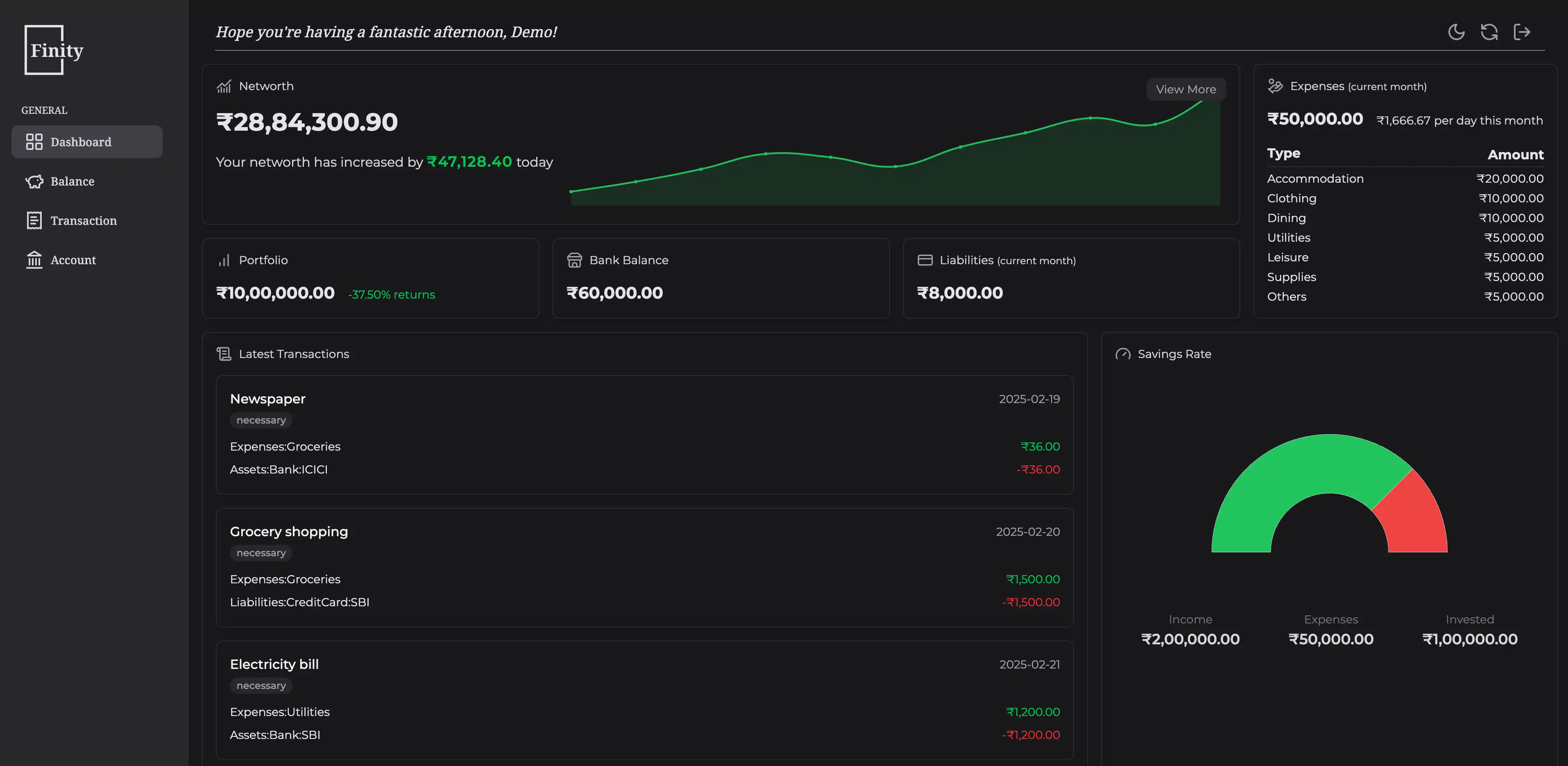
The dashboard prominently displays the most crucial metric - Networth and also gives a breakdown of assets and liabilities.
At a glance, I can view the top 6 expense categories for the current month, recent transactions, and most importantly - the savings rate for the month.
The whole idea is built around double-entry accounting system principles where every financial transaction impacts at least two accounts, ensuring accuracy and consistency in tracking.
For example
2021/12/01 * Dio Air * necessary
    Expenses:Vehicle  10.00
    Assets:Bank:SBI
So, in this example, I am saying that on 1st Dec 2021, I transferred 10 Rs from my SBI bank account to a Vehicle Expense account, which I tagged as a necessary expense with the description Dio Air. The same grammar can be used to show expenses made on a credit card.
2025/12/11 * Cheeze Pizza * unnecessary
    Expenses:Food  516.00
    Liabilities:CreditCard:AmazonICICI
I’ve been maintaining this file since December 2021, and the insights I can now extract from the dashboard are truly mind-blowing.
The added advantage of writing transactions in this format is that I can completely rewrite the software (this is the third iteration) and my data remains perfectly intact.
I don’t have to worry about losing all my insights if an app decides to discontinue their product.
Other features
Till now I just highlighted all the UI parts of the app. But there are many advantages of using the accounting format for storing transactions.
- Most apps incorrectly count credit card transactions twice as expenses - once during the purchase and again when paying the bill. Finity handles these as two distinct transactions: the first moves money from credit card to expense account (tagged as an expense), while the second is simply a transfer from bank account to credit card (not an expense).
- Every day around noon, my cron job fetches current values for all my investments. This means all my mutual funds and stocks update their current values daily, allowing me to see detailed changes in asset value whenever needed. It also backs up all the ledger files to S3 so that I don’t lose any data.
- Money loaned out is not counted as an expense. Most apps treat any bank or credit card deduction as an expense or cash outflow. However, in Finity, money loaned to someone is transferred to a separate loan account, which doesn’t affect the expense calculations.
- Every week, I reconcile the balances shown in Finity with my actual bank and credit card balances. During this reconciliation process, I sometimes discover discrepancies in my bank balance. After investigating, I often find that I received interest on my bank balance - something I would have completely overlooked without this tracking system.
- I can track cashback earned from credit cards thanks to the structured accounting format. The transaction below shows how I clear my entire credit card balance by deducting ₹2015 from my bank account, with any remaining difference automatically credited to my cashback account.
2022/09/14 Credit card Bill
Assets:Bank:ICICI  -2015.00
Equity:Cashback
Liabilities:CreditCard:FlipkartAxis = 0.00- I developed a small iOS widget to check current net worth and today’s change in net worth.
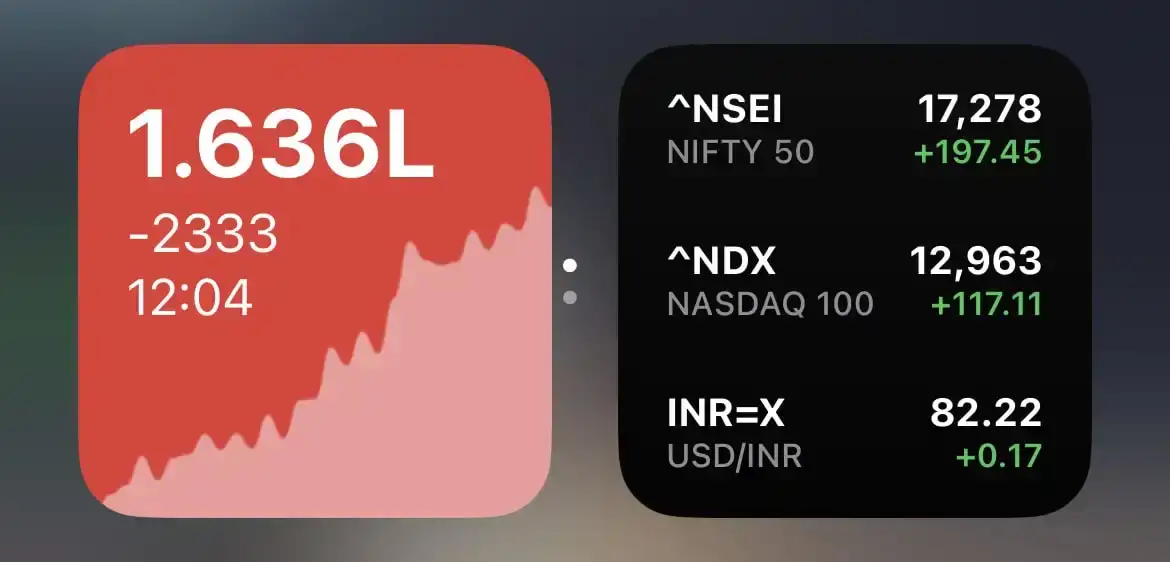
Features I would want
Even though I’m happy with my current setup, there are still some features I’d like to add:
- Asset tagging for specific goals. Currently, Finity doesn’t have any goal-tracking functionality. I’d love to be able to see how close I am to achieving my financial goals by tagging assets to specific objectives.
- Net worth projections. I’d like to create future trajectory predictions based on current trends, helping me visualize where my net worth might be in 5-10 years if current patterns continue.
Conclusion
Overall, just spending 5 minutes on a daily basis and recording my transactions in a file turned out to be an awesome exercise.
You can try out Finity here with demo data and see how minimal and clean the design is.